Empowering Higher Education for a Sustainable Future
The GREEN LEAF Framework (Learning, Engagement, and Action) provides a structured, adaptable, and participatory model to help institutions embed sustainability and climate action across all curricula.
Read More Join the Ambassador Network
Explore the LEAF Framework
What is the GREEN LEAF Framework?
Developed through a multi-phase, evidence-based process, the LEAF addresses the need for an integrated approach to sustainability in higher education. It transcends fragmented initiatives by connecting what we learn, who drives the change, and how that change materialises in the real world.
Mission
To establish conceptual and operational foundations for embedding sustainability across all disciplines and educational levels.
Alignment
Our framework is built upon international standards, including UNESCO’s Greening Curriculum Guidance and the EU’s GreenComp.
Key Statistics (Placeholder Values)

247
Best Practices
89
Green Ambassadors
156
Institutions
34
Countries
GREEN LEAF Framework
GREEN LEAF Framework
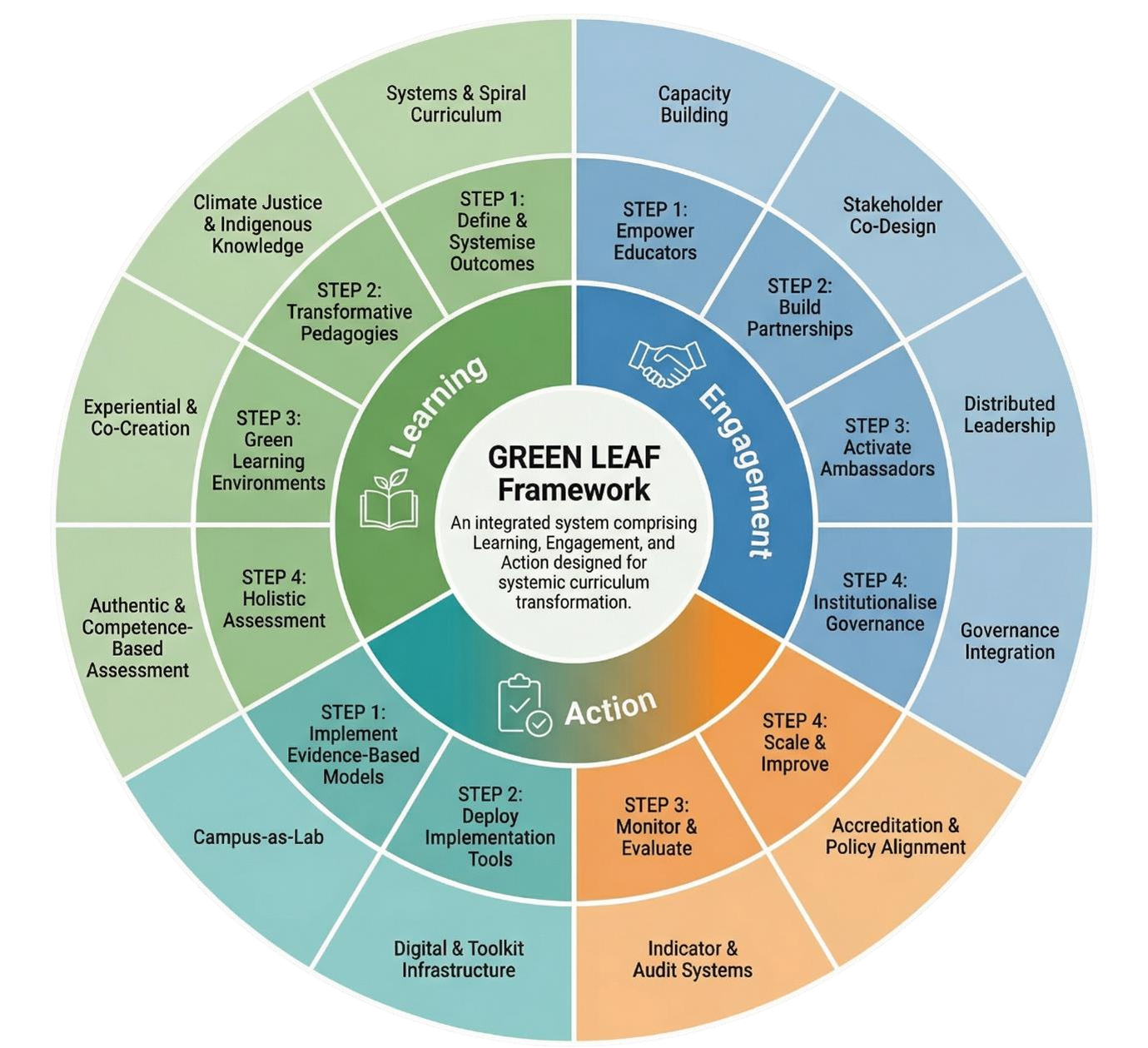
This visual presents the GREEN LEAF Framework as an integrated system connecting Learning, Engagement, and Action. It shows how the three pillars work together through interconnected steps, themes, and implementation pathways for systemic curriculum transformation.
Learning
Outcomes, pedagogies, environments, and assessment.
Engagement
Educators, stakeholders, ambassadors, and governance.
Action
Models, tools, monitoring, scaling, and improvement.
Integrated Framework Diagram
Where does your institution stand on curriculum greening?
Benchmark across Learning, Engagement and Action — and receive a visual maturity report with strengths, gaps and recommended next steps.
Rate
Score 55 benchmark statements on a clear 0–4 scale
Visualize
Get an instant institutional maturity report
Plan
Curated priority next steps for your institution
New Tool
LEAF Curriculum Mapping Tool
Map your programme's courses against learning outcomes and the GREEN LEAF sustainability metaconcepts. Reveal gaps, overlaps and progression problems, then track maturity with live dashboards and automated diagnostics.
Mapping matrices
Alignment, progression & integration.Sustainability layer
Six GREEN LEAF metaconcepts.Automated diagnostics
Coverage & progression flags.Live dashboards
Scores, heatmaps & maturity rating.Curriculum Mapping
Outcomes · Courses · Sustainability · Diagnostics
The LEAF Pillars
The LEAF Pillars
Three pillars of the LEAF
The LEAF provides the conceptual and operational foundation for greening higher education curricula. It connects what we learn (Learning), who drives and collaborates (Engagement), and how change happens (Action), forming a dynamic ecosystem that supports sustainability transformation.
The Learning Pillar
Transforming learning through green competencies, pedagogies, and environments.
The Engagement Pillar
Empowering people and partnerships to co-create sustainable education.
The Action Pillar
Translating knowledge and collaboration into real-world impact.
CONNECTION
Become a Green Learning Ambassador
The Network of Green Learning Ambassadors is the living heart of our framework. We mobilise students, educators, and community leaders to act as facilitators and innovators of sustainability.
Why Join?
Advocacy
Innovation
Community
Best Practices
Best Practices
- All
- Web Design
- Graphic Design
Testimonial
What the Green Ambassadors Say!
Diam dolor diam ipsum sit. Aliqu diam amet diam et eos. Clita erat ipsum et lorem et sit sed stet lorem sit clita duo justo.

Client Name
ProfessionDiam dolor diam ipsum sit. Aliqu diam amet diam et eos. Clita erat ipsum et lorem et sit sed stet lorem sit clita duo justo.

Client Name
ProfessionDiam dolor diam ipsum sit. Aliqu diam amet diam et eos. Clita erat ipsum et lorem et sit sed stet lorem sit clita duo justo.

Client Name
Profession


LEAF Pillar
Learning Pillar
Transforming learning through green competencies, pedagogies, and environments.
Transforming learning through green competencies, pedagogies, and environments.
Includes
- Green learning outcomes aligned with sustainability competencies (knowledge, values, skills, and agency).
- Content integration: embedding sustainability themes across disciplines.
- Pedagogies: experiential, systems-thinking, place-based, transformative.
- Learning environments: physical, digital, and community spaces that model sustainable practices.
Learning Pillar informs
- The Guidebook/Manual, by outlining how to design, teach, and assess for sustainability.
- The Tools and Resources for Faculty, providing teaching templates, pedagogical models, and learning environment examples.
Transformation dimensions
The Learning Pillar of the LEAF Framework positions learning design—rather than isolated sustainability content—as the central lever for greening higher education. Evidence from the GREENUS systematic review indicates that curriculum greening is most effective when sustainability is embedded systematically across learning outcomes, disciplinary structures, pedagogical approaches, and learning environments, rather than addressed through stand-alone courses or ad hoc initiatives.
The Learning Pillar frames sustainability learning as a competence-based and developmental process, integrating cognitive, socio-emotional, and behavioural dimensions. It recognises that higher education institutions play a critical role in equipping learners not only with disciplinary expertise, but also with the capacities required to understand complexity, exercise ethical judgment, and contribute to sustainable transitions within professional and societal contexts.
To translate these principles into practice, the LEAF Framework proposes a structured learning pathway built around four Learning Steps (lSTEPS). These steps provide a practical sequence for designing, implementing, and sustaining green learning across curricula and learning environments. Each lSTEP identifies core curriculum and pedagogical actions—what institutions must put in place—and learning practices—how these actions are realised in concrete educational settings.
The four lSTEPS guide higher education institutions in addressing four interconnected dimensions of learning transformation within the GreenUS Framework: Learning Outcomes • Curriculum Integration • Pedagogical Practice • Learning Environments
They also support institutions in aligning teaching, assessment, and educational spaces with sustainability goals as part of a whole-institution approach. The four lSTEPS are:
lSTEP 1 — Define and Systemise Green Learning Outcomes.
Align programmes and courses with sustainability competencies across cognitive, socio-emotional, and behavioural domains.
lSTEP 2 — Integrate Sustainability Across Disciplines.
Embed sustainability coherently across all fields of study using interdisciplinary and spiral curriculum approaches.
lSTEP 3 — Apply Transformative and Experiential Pedagogies.
Use learnercentred, experiential, and reflective teaching approaches to foster critical thinking, ethical reasoning, and learner agency.
lSTEP 4 — Activate Diverse and Sustainable Learning Environments.
Leverage physical, digital, and community-based spaces as living environments that support applied sustainability learning.
Goal: Align learning outcomes with green competencies and global greening indicators.
Innovation in content involves moving beyond adding isolated topics to reshaping the entire curriculum through a "spiral curriculum" approach, where key concepts are revisited with increasing complexity (UNESCO, 2024b).
This step initiates the holistic transformation of higher education by transitioning from the fragmented insertion of environmental topics to a systematic restructuring of the educational experience. Innovation in content centres on the "spiral curriculum" approach, ensuring that core concepts—such as climate science, resilience, and post-carbon economics—are revisited across all levels of study with increasing depth and complexity.
The Global Greening Curriculum Indicator (SDG 4.7.1) supports institutions with moving beyond subjective reporting to objective, evidence-based mainstreaming of green themes in the official intended curriculum. The following table outlines core actions and innovative practices recommended to achieve alignment.
| Core actions | Key practices |
|---|---|
| Align with Greening Indicators |
|
| Integrate Systems Thinking |
|
| Infuse Climate Justice |
|
| Leverage Indigenous and under-represented Knowledge |
|
Box 1. The EDINSOST Project: Improving Sustainability Education
The EDINSOST R+D+i project strengthens sustainability education in Spanish higher education. Funded by national research programs, it brings together ten universities to develop common frameworks for integrating sustainability competencies into curricula.
The project maps sustainability skills across degrees, validates innovative teaching strategies, assesses faculty training needs, and evaluates student learning outcomes. Special focus is given to Education and technological degrees due to their long-term societal impact.
EDINSOST promotes a coordinated, holistic approach to embedding environmental, social, and economic sustainability into university education.
Box 2. GreenComp Assessment for Trans-for-ma-tive Education
GATE is a three-year Erasmus+ project (2025–2028) that helps secondary schools across Europe place sustainability at the heart of everyday school life. Rather than treating sustainability as just another subject, GATE encourages schools to live it — in the classroom, in decision-making, and in their relationship with the wider community.
Inspired by the European GreenComp framework, the project develops practical self-evaluation tools, training for teachers and school leaders, and a Sustainability School Certification Model that recognises meaningful progress. Students are active contributors in shaping more sustainable school environments.
Goal: Shift from passive transmission to learner-centred, action-oriented experiences.
The transition from knowledge acquisition to the cultivation of sustainable agency requires a fundamental shift in how learning occurs. This second step of the Learning Pillar focuses on moving beyond the passive transmission of climate facts toward learner-centred, action-oriented experiences (UNESCO, 2024b). By adopting transformative pedagogies, higher education institutions empower students to evolve from recipients of information into active agents of change capable of navigating complex, real-world socio-ecological challenges.
Innovation in this step addresses the socio-emotional and behavioural dimensions of learning, ensuring that climate knowledge serves as a catalyst for positive attitudinal shifts and collective resilience rather than inducing eco-anxiety or powerlessness (GEM Report UNESCO, 2024) see Table 3.
| Core Actions | Key Practices |
|---|---|
| Adopt Experiential Pedagogies |
|
| Utilise Digital Innovations |
|
| Foster Co-Creation |
|
| Practice Reflexive Inquiry |
The shift towards transformative and applied pedagogies represents a necessary evolution from knowledge transmission to competence formation and agency development. In line with international guidance on Education for Sustainable Development, this step recognises that sustainability learning must engage cognitive, socio-emotional and behavioural dimensions simultaneously. Experiential and project-based approaches link theory to real-world challenges, enabling learners to apply systems thinking and problemsolving skills in authentic contexts. Digital innovations, including AI-supported personalisation and immersive simulations, further extend these possibilities by creating adaptive and ethically guided learning pathways that allow students to explore complex sustainability scenarios without real-world risk.
Equally critical is the emphasis on co-creation and reflexive inquiry. Participatory methods such as dialogic gatherings reposition learners and educators as partners in knowledge construction, fostering shared responsibility and democratic engagement. The Jornadas Pedagógicas at the University of Lisbon (see Box 3) exemplify how structured, institution-wide dialogue can catalyse pedagogical renewal by creating horizontal spaces for reflection and exchange across the academic community. Such practices operationalise transformative learning principles, embedding sustainability not only in curriculum content but also in institutional culture.
Box 3. Example of dialogic gatherings to navigate pedagogical innovation
The Jornadas Pedagógicas, established by the University of Lisbon (ULisboa) in 2022, exemplify the use of dialogic gatherings to foster institutional transformation and pedagogical innovation. These events are structured as regular cycles of sharing and reflection that bring together the entire academic community—including students, teachers, researchers, and technical-administrative staff— to discuss themes of common interest and reinforce cooperation.
By focusing on a specific annual theme, the Jornadas promote a horizontal space for discussion and the exchange of experiences regarding pedagogical methodologies. This approach directly aligns with transformative learning principles, which shift the educational paradigm from one-way information transmission to dialogue and negotiation among egalitarian partners. Within the GREEN LEAF Framework, such gatherings serve as a critical mechanism for co-constructing knowledge, allowing stakeholders to become active co-creators of their learning environments.
Goal: Transform campuses and digital platforms into living laboratories.
The environment must model the sustainability principles being taught, bridging the gap between classroom knowledge and civic life (UNESCO, 2024b). Thus, the third step of the Learning Pillar shifts the focus from pedagogy to the physical, digital, and communitybased settings where learning occurs. Consistent with the Whole-Institution Approach (WIA), this step recognizes that the learning environment is not a neutral backdrop but an active mediator of educational experience – see Table 4. To get every learner "climateready," the institution must "walk the talk" by transforming its own operations and platforms into living laboratories for sustainability. Transitioning to green learning environments requires cross-sectoral collaboration between academic departments and facilities management. This integrated model provides high-impact outcomes by allowing students to acquire hands-on skills in real-world systems, such as biodiversity mapping or lifecycle assessments of campus buildings. As highlighted by the Greening Education Partnership, these environments foster a culture of inquiry and responsibility, preparing graduates to navigate the complexities of the Anthropocene with humility and critical reflexivity.
| Core Actions | Key Practices |
|---|---|
| Establish Campus-as-Lab |
|
| Enhance Place-Based Settings (UNESCO, 2024a) |
|
| Adopt Embodied Learning |
|
| Ensure Digital Sustainability |
|
The third learning step consolidates the Whole-Institution Approach by positioning the campus and its ecosystem as active pedagogical actors. In line with international guidance that calls on institutions to “walk the talk,” green learning environments operationalise sustainability through institutional practice, ensuring coherence between what is taught and what is lived. The Campus-as-Lab model exemplifies this integration: by embedding student research within operational systems—energy monitoring, waste audits, biodiversity mapping or lifecycle assessments—institutions convert infrastructure into educational capital. This approach strengthens applied competences and also institutional accountability, as benchmarking tools and participatory planning frameworks connect learning outcomes with measurable sustainability performance.
The Living Laboratory Seed Fund at University College Cork (see Box 4) demonstrates how structured funding mechanisms can catalyse this model by linking crossdisciplinary research with campus operations and open knowledge sharing.
Box 4. Sustainability & Climate-Action Living Lab Seed Fund
The University College Cork (UCC) Living Laboratory Seed Fund, established by UCC Green Campus and funded by the HEA, empowers students and staff to use their research capabilities to solve realworld sustainability issues related to institutional infrastructure and practices. By using the university itself as a "testbed," the programme bridges the gap between academic theory and operational reality. Core Objectives of the Programme:
- Real-Life Problem Solving: Projects are designed to address tangible challenges within the campus or local community.
- Cross-Boundary Partnerships: Initiatives must be based on collaborations that cross disciplinary or sectoral boundaries.
- Iterative Testing: Ideas are trialled in real-life settings to allow for the continuous refinement of solutions.
- Open Knowledge Sharing: Data and findings generated by funded projects are shared openly to foster collective learning.
Launched in 2019, the programme is now in its third funding round (as of July 2023), specifically supporting UCC’s Sustainability and Climate Action Plan (2023–2028). Notable projects include "Re-UCC," which focuses on campus waste prevention through re-use, the UCC Open Arboretum, and "Plastics Free UCC," which explores social and marketing levers to reduce plastic dependency. This programme exemplifies the "Campus-as-Lab" model, transforming the university into a vital mediator of sustainability experience (UCC Living Laboratory, 2023).
Box 5. Land Use Change for the Green Transition: The Åmosen Living Lab
Coordinated by the Green Solutions Centre at the University of Copenhagen (UCPH), this Living Lab addresses the complex interests, conflicts, and environmental dilemmas arising from land use changes during the green transition. It serves as a platform to generate and co-create solutions with all partners relevant to land use planning and the rewetting of drained wetland areas.
Core Focus and Activities:
- Geographic Focal Point: The lab revolves around the drained wetlands and regulated streams of Åmosen in Western Zealand.
- Restoration of Carbon-Rich Soils: A primary objective is developing specific pathways for the rewetting of carbon-rich soils, a critical measure for climate change mitigation.
- Scalable Lessons: The findings and strategies developed in Åmosen are designed to be transferable to other geographical sites involving the restoration of carbon-rich ecosystems. This initiative exemplifies the "Campus-as-Lab" model, transforming academic research into an active tool for social and ecological intervention. By involving researchers, students, and external stakeholders, the university acts as a vital mediator of sustainability experience, bridging the gap between theoretical knowledge and real-world landscape transformation.
Beyond physical infrastructure, place-based and embodied learning practices strengthen ecological literacy and ethical reflection by grounding sustainability in local contexts and lived experience. Ensuring digital sustainability further expands this responsibility, requiring institutions to critically assess the material footprint of educational technologies and design low-impact, open-access systems.
Goal: Measure transformation across cognitive, socio-emotional, and behavioural domains.
Assessment must evolve beyond simple knowledge testing to evaluate the development of green agency (UNESCO, 2024a, 2024b).
Assessment serves as the final mechanism for validating the transition from theoretical knowledge to demonstrated green agency. In alignment with the OECD’s focus on "agency in the Anthropocene" and UNESCO’s transformative learning agenda, this step moves beyond traditional testing of scientific facts to evaluate a learner’s capacity for complex problem-solving, ethical reasoning, and collective action. Assessment must be holistic, capturing not only intellectual mastery but also the socio-emotional dispositions—such as empathy and resilience—and the behavioural commitment required to navigate climate uncertainties. To ensure high-quality outcomes, assessment practices must transition from a "one-size-fits-all" model to an adaptive framework that recognizes diversity in learner backgrounds and contexts. Actionable implementation requires institutions to move away from "about" learning to "for" sustainable development, using validated, reliable measures to track long-term behavioural shifts.
| Core Actions | Key Practices |
|---|---|
| Measure Green Competencies |
|
| Utilise Authentic Products (UNESCO, 2024) |
|
| Implement Digital Badging |
|
| Integrate Continuous Feedback |
|
The fourth learning step consolidates curriculum transformation by aligning assessment with the development of green agency. Assessment is, thus, repositioned as a mechanism for evaluating learners’ capacity to apply systems thinking, exercise ethical judgment and act collectively in conditions of uncertainty. Measuring sustainability competences therefore requires tools that capture cognitive mastery alongside socioemotional dispositions—such as empathy and resilience—and observable behavioural commitments. Aligning audits and evaluation criteria with frameworks such as GreenComp strengthens coherence and comparability, while ensuring that learning outcomes are anchored in recognised sustainability competences.
The shift toward authentic and adaptive assessment practices operationalises this ambition. Evaluating portfolios, action plans and project-based outputs moves assessment from abstract testing to situated problem-solving, while peer review and deliberative formats assess relational agency and collaborative capacity. Digital badging and competency-based recognition systems further connect sustainability learning with employability and international standards, reinforcing the workforce relevance of green competences. Continuous feedback loops, including social-emotional self-assessment, support iterative learning and well-being monitoring, ensuring that transformation is sustained rather than episodic.
The experience of TU Dublin’s competency mapping initiative ( Box 6) illustrates how structured, evidence-based audits can inform curriculum redesign. Specific sustainability competences are identified and integrated with co-creation practices.
Box 6. o-Create & NEMOS: Competency Mapping for Evidence-Based Transformation
TU Dublin’s School of Food Science and Environmental Health utilized a custom mapping tool, based on the AASHE STARS framework, to systematically audit its BSc Food Innovation degree. This process identified 70 specific sustainability competencies required to guide a comprehensive curriculum redesign. The initiative uniquely integrates student co-creation with continuous professional development for staff, ensuring that learning outcomes remain adaptive and grounded in the complex needs of the global food system (Dunne et al., 2023).
LEAF Pillar
Engagement Pillar
Empowering people and partnerships to co-create sustainable education.
Empowering people and partnerships to co-create sustainable education.
Includes
- Educators as facilitators of transformation.
- Stakeholders (NGOs, policymakers, institutions, communities) as co-implementers.
- Green Learning Ambassadors as the living network sustaining collaboration and innovation.
Engagement Pillar informs
- The Online Digital Catalogue, which captures and disseminates best practices from diverse contexts.
- The Ambassadors Network, ensuring ongoing knowledge exchange and adaptation.
Transformation dimensions
The Engagement pillar of the LEAFs positions people—rather than content, tools, or technology—as the driving force of green transformation in higher education. Evidence shows that curriculum greening succeeds when educators, institutional leaders, students, and external partners collaborate as co-creators of knowledge and practice, rather than passive recipients of top-down strategies. This approach reflects principles highlighted in UNESCO’s Greening Curriculum Guidance (2024) and the Green School Quality Standard (2024), which emphasise shared responsibility, distributed leadership, and participatory decision-making as foundations for whole-institution transformation.
To operationalise these insights, the LEAF Framework proposes a structured engagement pathway built around four Engagement Steps (eSTEPS). These steps provide an actionable sequence for building, strengthening, and institutionalising the human relationships and collaborative cultures necessary for greening higher education. Each eSTEP identifies core actions—the strategic moves institutions must take—and key practices—the concrete activities that bring these actions to life.
The four eSTEPS guide higher education institutions in engaging three central human domains of the GreenUS Framework: Educators • Stakeholders • Ambassadors
They also enable institutions to embed engagement into governance systems and long-term organisational culture.
The four eSTEPS are:
eSTEP 1 — Engage and Empower Educators.
Build educator capacity, motivation, and collaborative structures for sustainability teaching.
eSTEP 2 — Build Strategic Partnerships with Stakeholders.
Expand sustainability learning beyond the university through inclusive, community-rooted collaborations.
eSTEP 3 — Activate a Network of Green Learning Ambassadors.
Mobilise students, staff, and partners as catalysts of sustainability engagement and innovation.
eSTEP 4 — Institutionalise Engagement through Structures and Governance.
Embed engagement into policies, decision-making, quality assurance, and long-term institutional systems.
Goal: Build educator capacity, motivation, and collaborative structures
Educators are the primary catalysts of sustainability learning. This step focuses on enabling them to teach differently, collaborate meaningfully, and innovate confidently (Table 6).
| Core actions | Key practices |
|---|---|
| Provide training in transformative and sustainability pedagogies (UNESCO, 2024) |
|
| Create cross-disciplinary teaching teams |
|
| Offer incentives (time, recognition, micro-grants) |
|
| Establish educator communities of practice |
|
| Encourage co-design of modules and assessment |
|
The core actions proposed in eSTEP 1 reflect the complementary conditions required to build educator engagement as a foundation for curriculum greening. Providing structured training in transformative and sustainability pedagogies is essential for equipping educators with the epistemic, methodological and affective capacities demanded by sustainability learning. Yet pedagogical upskilling alone is insufficient without organisational arrangements that support collective work. Cross-disciplinary teaching teams (see Box 7), for example, respond to the inherently systemic and transdisciplinary nature of sustainability challenges, enabling educators to transcend disciplinary silos and co-construct integrative learning experiences. Incentive structures—including time allocation, recognition and microgrants—further signal institutional commitment, addressing well-documented barriers related to workload, legitimacy and competing academic priorities.
Equally important are communities of practice (see Box 8), which provide the social infrastructure for sustained professional learning, enabling educators to share practices, negotiate meaning and normalise innovation in a supportive environment.
Finally, co-design processes ensure that sustainability teaching is not developed in isolation but emerges through participatory collaboration with students, colleagues and external stakeholders, enhancing relevance, ownership and pedagogical coherence ( Box 9).
Box 7. EELISA Communities as catalysts for cross-disciplinary teaching teams
The EELISA Communities are mission-driven collaboration platforms that play a central role in reshaping higher education across the European Engineering Learning Innovation and Science Alliance (EELISA). These Communities bring together students, educators, researchers, professional staff and external stakeholders — including public institutions, companies and civil society actors — to address real-world societal and environmental challenges from interdisciplinary perspectives. Hosted and coordinated through the EELISA Digital Campus, the Communities serve as dynamic hubs where cross-disciplinary teaching teams can form, grow and thrive. They go beyond traditional academic silos, enabling educators from diverse fields to design and deliver learning experiences that integrate knowledge from multiple disciplines, such as engineering, social sciences, arts and environmental studies.
Key features of EELISA Communities as boosters of cross-disciplinary teaching teams:
- Shared Mission and Real-World Focus: Each Community is oriented toward pressing global challenges and the Sustainable Development Goals (SDGs). This mission-driven approach naturally encourages educators to combine expertise from different disciplines to co-design curricula, project-based learning activities, and challenge-based learning experiences rooted in real problems.
- Collaborative Team Formation: By bringing together educators with varied backgrounds alongside students and external partners, EELISA Communities foster cross-disciplinary teaching teams whose collective strengths enrich the learning journey and expand educational impact.
- Experiential and Impact-Oriented Learning: Activities within Communities — from collaborative workshops and think tanks to joint research and SDG-oriented projects — create fertile ground for educators to embed active, participatory and transdisciplinary pedagogies into their teaching practice.
Box 8. The GlobeCOP – an international community of practice for sustainability and STEAMSS
GlobeCOP (Global Learning Opportunities for Green and Sustainability Education in STEAM and Social Sciences Community of Practice) is an international, collaborative network developed under the GLOBE-STEAMSS project. It brings together educators, researchers, students and professionals across Europe who are engaged in advancing sustainability, digital transformation and inclusive education in STEAMSS (Science, Technology, Engineering, Arts, Mathematics and Social Sciences). The community serves as a dynamic space for shared learning, co-creation and professional growth, enabling members to:
- Exchange experiences and best practices in innovative teaching, curriculum design and sustainability education.
- Develop green, digital and entrepreneurial competencies that are crucial for future-oriented education.
- Collaborate on real-world challenges through joint projects, design challenges and hackathons that connect theory with practical action.
- Access a dedicated digital platform offering resources, tools, teaching materials and a shared educational ecosystem to support inclusive and open learning.
GlobeCOP is designed as a supportive, interdisciplinary network that strengthens community-driven innovation in education, fosters global knowledge exchange, and empowers educators to shape the future of teaching and learning in a rapidly changing global landscape.
Box 9. The Social Tech Hub at UCLL as a co-design space
The Social Tech Hub serves as a collaborative space for students, startups, and local communities to co-create tech-driven solutions to societal challenges. It will focus on developing and implementing innovation action plans, delivering entrepreneurship programs, and providing mentorship for aspiring tech entrepreneurs. By building strong partnerships with industry leaders, startups, and other academic institutions, the hub will support technology transfer and help bridge the gap between academic research and real-world applications.
Goal: Expand green learning beyond the university walls
Sustainability becomes transformative when HEIs collaborate with the community and external partners. UNESCO stresses that greening education must be inclusive, participatory, and community rooted.
eSTEP 2 focuses on strengthening the role of higher education institutions as anchoring actors within regional sustainability ecosystems. Moving beyond internal capacity-building, this step addresses how universities deliberately engage with municipalities, civil society organisations, industry, and other external partners to co-create meaningful sustainability learning opportunities. The core actions defined in eSTEP 2 reflect a shift from episodic collaboration toward structured, long-term, and pedagogically embedded partnerships. This approach aligns with international policy frameworks that emphasise community-rooted, participatory, and action-oriented education for sustainable development. UNESCO’s Greening Curriculum Guidance highlights that sustainability learning becomes transformative when learners engage with real-world actors, contexts, and challenges, while GreenComp underscores the importance of collective action, political agency, and systems thinking as key sustainability competencies.
| Core actions | Key practices |
|---|---|
| Identify and map relevant stakeholders |
|
| Co-create sustainability projects with partners |
|
| Integrate stakeholder expertise into teaching |
|
| Facilitate experiential, community-based learning |
|
| Establish stakeholder advisory boards |
|
The first core action in eSTEP 2—identifying and mapping relevant stakeholders— establishes the foundation for effective collaboration. Rather than relying on informal or ad hoc partnerships, institutions are encouraged to adopt a strategic approach that recognises the diversity of actors shaping local and regional sustainability transitions. Systematic stakeholder mapping enables institutions to prioritise partners whose expertise and mandates align with pressing sustainability challenges, while formal collaboration agreements help ensure continuity, clarity of roles, and mutual commitment over time. The example in Box 10 illustrates how different institutions have operationalised stakeholder mapping and long-term engagement to support curriculum-relevant collaboration, demonstrating the value of intentional partnership design.
Furthermore, the stakeholders become co-designers of learning. Involving partners in defining project briefs and supervising student work ensures that learning activities respond to real-world needs and policy priorities, while formats such as living labs and challenge-based learning provide structured environments for collaboration. This practice supports learners in developing applied sustainability competencies by engaging with complexity, uncertainty, and competing interests. It also reinforces the role of higher education institutions as contributors to regional climate strategies and SDG implementation, as illustrated in the accompanying box ( Box 11) showcasing co-created projects linked to urban resilience, education innovation, and regional development agendas.
A further core action in eSTEP 2 is the integration of stakeholder expertise into teaching. This goes beyond occasional guest lectures to encompass sustained pedagogical involvement through joint seminars, practitioner-led case studies, and stakeholder-inresidence or mentoring roles. Such practices diversify epistemic perspectives within the curriculum and expose learners to applied knowledge, professional practices, and lived experience (see Box 12).
Moreover, facilitating experiential, community-based learning—recognises that sustainability learning is deeply contextual. Fieldwork, service-learning, site visits, and community-based challenges allow learners to engage directly with local sustainability dynamics, including social, environmental, and cultural dimensions. Importantly, this action also foregrounds the role of community and Indigenous knowledge in contextualising academic learning, thereby promoting epistemic plurality and social justice.
The final core action in eSTEP 2—establishing stakeholder advisory boards— supports the long-term alignment of teaching and learning with societal needs. Advisory boards create structured spaces for dialogue between universities and external actors, enabling regular reflection on curriculum relevance, responsiveness, and impact. Including diverse representatives—such as youth, NGOs, policymakers, and industry—ensures plural perspectives and strengthens accountability.
Box 10. Academic-driven stakeholder mapping in the NEXTFOOD project
NEXTFOOD is a European-funded project aimed at transforming education and training for sustainable agrifood and forestry systems. It promotes a shift from top-down knowledge transfer toward learner-centric, action-based approaches where students, researchers, farmers, and other stakeholders collaborate on real sustainability challenges.
The project built a research and education-driven partnership of 19 organisations across 13 countries and 3 continents. The consortium was anchored by universities and specialised training institutions, ensuring that stakeholder engagement remained pedagogically grounded.
To complement this academic core, the project established a Stakeholders' Advisory Board (SAB) bringing in agricultural cooperatives, regional governments, foundations, and industry actors. Critically, SAB members were engaged throughout the project's lifetime, enabling sustained, curriculum-relevant collaboration rather than one-off consultations. This intentional two-tier structure enabled partners to co-develop case-based action learning grounded in real sustainability challenges.
Box 11. Example of co-creation practices in response to the need to build resilient and sustainable cities
Faced with demographic growth, climate change and the digital revolution, the question of how to build sustainable, resilient and welcoming cities for all has become one of the defining challenges of the 21st century. Meeting this challenge requires a coordinated effort from the academic world, businesses, local authorities and society at large.
To remain at the forefront of innovative research, to train the future professionals who will shape tomorrow’s cities, and to strengthen its capacity to transfer knowledge to industry, the École nationale des ponts et chaussées is investing in a new co-creation space: the Co-Innovation Lab.
This laboratory is designed as a multidisciplinary hub where researchers, students and companies can work together to accelerate innovation. It responds simultaneously to three key needs:
- Advancing research and innovation through state-of-the-art facilities that foster crossfertilisation of knowledge, data analysis, experimentation and large-scale prototyping.
- Boosting the competitiveness of companies by enabling them to co-innovate with École des Ponts researchers, laboratories and scientific equipment through collaborative research partnerships.
- Enriching education and training by opening innovation spaces to professors and students and integrating experimental insights directly into teaching.
Through the Co-Innovation Lab, the École des Ponts positions itself as a catalyst for new ideas, new methods and new professions dedicated to building the cities of the future.
Box 12. Integrating Stakeholder Expertise Through the LEARNathon and Challenge-Based Learning
The LEARNathon (Learning, Engagement and Research Nexus Hackathon), developed at National University of Science and Technology POLITEHNICA Bucharest, offers an example of how stakeholder expertise can be meaningfully integrated into teaching through challenge-based learning (CBL) and hybrid university–school partnerships. Designed within Initial Teacher Education programmes, the LEARNathon connects pre-service teachers, schoolteachers, pupils, and university educators to collaboratively address real challenges linked to the Sustainable Development Goals (SDGs).
A Two-Stage Collaborative Learning Ecosystem
The initiative is structured as a multi-actor learning environment composed of two interlinked stages:
- The LEARNathon — University-Based Co-Design with Stakeholders. Pre-service teachers work in mixed teams to address authentic educational challenges presented by instructors and school partners. They draw on stakeholder expertise—including school practitioners and educational researchers—to develop prototypes such as serious games; interactive teaching materials; apps and digital tools; workshops and training programmes
- EduFest — School-Based Implementation and Testing. The most promising designs are implemented with pupils in local schools during EduFest, a festival-style collaborative event. Schoolteachers, pupils, and university mentors participate in testing, evaluating, and refining the learning experiences. This step ensures real-world applicability, iterative improvement, and mutual learning across educational levels.
Box 13. Example of community-based learning
An illustrative example of community-based learning is the development of a transnational online educator learning community within an Erasmus+ cooperation project focused on inclusive digital entrepreneurship for adults with migrant backgrounds. The community was created in response to concrete societal challenges related to social inclusion, employability, and unequal access to entrepreneurial opportunities, particularly in digitally driven economies. Adult educators from higher education institutions, NGOs, and adult education centres across multiple European countries engaged in a shared learning space where professional learning emerged through peer exchange, co-creation of teaching resources, and reflection on real-world educational practice. Grounded in the everyday realities of working with migrants and vulnerable adult learners, the community enabled educators to connect theory with practice, adapt pedagogical approaches to diverse local contexts, and collectively develop more inclusive and responsive learning strategies. Rather than functioning as a static platform, the community operated as a living learning ecosystem in which continuous interaction, feedback loops, and shared responsibility supported communitybased learning, professional agency, and sustainable educational innovation.
Box 14. PROMEnhance Booklet
Cooperation with local authorities, CSOs and HEI for certifying competences on territorial development (PROMEnhance Booklet) - as a result of the work done within the project, the Erasmus+ PROMEnhance partnership released a Booklet with 11 practical recommendations for Higher Education Institutions on how to improve and institutionalise cooperation with external stakeholders in the provision of certified programs.
Goal: Mobilise students, staff, and partners as catalysts of sustainability engagement and innovation
eSTEP 3 focuses on mobilising people as agents of change by activating a Network of Green Learning Ambassadors across the institution and its partner ecosystems. While eSTEP 2 establishes structured partnerships with external stakeholders, eSTEP 3 concentrates on human agency, leadership, and peer-driven innovation, recognising that sustainability transformation depends not only on formal structures but on empowered individuals who can catalyse change from within.
This step reflects growing evidence that student and staff leadership, when meaningfully supported, plays a critical role in embedding sustainability across teaching, learning, and campus life. International frameworks such as GreenComp or the Learning Compass emphasise competences related to political agency, collective action, and individual initiative, highlighting the importance of enabling learners and educators to move from awareness to action eSTEP 3 operationalises these competences by creating formal pathways for participation, leadership, and recognition.
| Core actions | Key practices |
|---|---|
| Identify and recruit ambassadors |
|
| Train ambassadors in sustainability leadership |
|
| Enable ambassadors to lead initiatives |
|
| Embed ambassadors into institutional structures |
|
| Recognize and showcase ambassador contributions |
|
The following section, The Living Component: Network of Green Learning Ambassadors, operationalises eSTEP 3 by detailing the core actions, key practices, and illustrative examples through which such networks can be established, supported, and sustained.
Goal: Embed engagement into policies, decision-making, quality assurance, and long-term institutional systems.
eSTEP 4 represents the transition from activation to institutional permanence. While earlier steps focus on building partnerships (eSTEP 2) and mobilising people as change agents (eSTEP 3), eSTEP 4 addresses the conditions required to ensure that sustainability engagement becomes embedded, sustained, and resilient beyond individual projects, champions, or funding cycles.
At this stage, sustainability engagement is no longer treated as an add-on or an experimental initiative. Instead, it is integrated into the formal systems that shape how the institution plans, governs, evaluates, and allocates resources. This reflects a core insight from international frameworks on education for sustainable development: transformative change in higher education requires alignment between pedagogical innovation and institutional governance.
The core purpose of eSTEP 4 is to translate the momentum generated through educator engagement, stakeholder collaboration, and ambassador networks into durable institutional arrangements. This includes embedding sustainability engagement within strategic plans, policy frameworks, and key performance indicators, thereby signalling longterm institutional commitment and accountability. Alignment with broader policy agendas— such as the Sustainable Development Goals, the EU Green Deal, and national climate education strategies—further situates institutional action within wider societal transformations. Unlike eSTEP 2, where external stakeholders are primarily engaged as co-creators of learning, eSTEP 4 positions stakeholders, students, and ambassadors within governance and oversight roles. Sustainability councils, steering committees, and advisory bodies provide structured spaces where diverse perspectives inform decision-making, curriculum priorities, and institutional direction. This shift from collaboration to governance is a defining feature of eSTEP 4.
| Core actions | Key practices |
|---|---|
| Embed sustainability engagement in institutional policy |
|
| Establish sustainability governance bodies |
|
| Align curriculum governance with sustainability goals |
|
| Support engagement through institutional infrastructure |
|
| Monitor, evaluate, and report engagement progress |
|
A central dimension of institutionalisation concerns curriculum governance. eSTEP 4 emphasises the need to systematically align programme approval, review, and quality assurance processes with sustainability goals. Tools such as sustainability mapping, GreenComp-aligned audits, and dedicated quality indicators enable institutions to move from isolated examples of good practice toward coherent, institution-wide curriculum transformation.
Box 15. Green Office Model
One practical mechanism for institutionalising sustainability engagement in higher education is the Green Office model, developed through the international Green Office Movement. A Green Office is a formal university unit—often student-led and staff-supported—dedicated to advancing sustainability across the institution’s education, research, operations, and community engagement activities. Unlike temporary initiatives or student clubs, Green Offices are embedded within the institutional structure and receive official recognition, resources, and a mandate to coordinate sustainability action across campus.
Typically located within university governance structures, Green Offices function as bridging organisations between students, staff, administrators, and external partners. Their role is to translate institutional sustainability commitments into concrete initiatives, while also ensuring that the voices of students and the wider campus community are represented in decision-making processes. In this way, they help integrate grassroots engagement with formal governance structures.
Examples such as the Green Office Wageningen and the Maastricht University Green Office demonstrate how these units can support long-term institutional change. Their activities include coordinating sustainability strategies, facilitating interdisciplinary projects, organising training and awareness campaigns, supporting curriculum greening initiatives, and advising university leadership on sustainability policy. By combining operational support with participatory governance, Green Offices provide a stable platform for experimentation, collaboration, and institutional learning.
LEAF Pillar
Action Pillar
Translating knowledge and collaboration into real-world impact.
Translating knowledge and collaboration into real-world impact.
Includes
- Models and Practices demonstrating effective curriculum greening.
- Resources and instruments for implementation and evaluation.
- Monitoring tools for continuous improvement and evidence-based practice.
Action Pillar informs
- The Guidebook/Manual, providing practical steps, frameworks, and evaluation tools.
- The Digital Catalogue, showcasing case studies and models in action.
- The Faculty Tools, equipping educators and leaders to act effectively.
Transformation dimensions
The Action Pillar constitutes the operational core of the GREEN LEAF. While the Learning and Engagement pillars establish conceptual foundations and collaborative ecosystems, the Action Pillar ensures that these commitments translate into measurable institutional change. It shifts the focus from intention to implementation, embedding sustainability within governance procedures, resource allocation, quality assurance systems and institutional performance metrics. In line with international guidance on greening education systems, this pillar positions higher education institutions as knowledge producers and accountable actors in the green transition.
The Action Pillar therefore emphasises implementation fidelity, scalability and impact verification. It requires institutions to adopt evidence-based models, deploy structured tools, monitor competence development systematically and align improvement cycles with accreditation and reporting mechanisms. Consequently, the pillar establishes sustainability as a managed, auditable and continuously improving institutional process.
To operationalise this ambition, the Action Pillar is structured through four interlinked Action Steps (aSTEPS):
aSTEP 1 — Implement Evidence-Based Models and Practices.
Adopting verified curriculum greening models to ensure scientific and pedagogical rigor.
aSTEP 2 — Deploy Practical Resources and Implementation Instruments
Institutionalise sustainability reform by embedding structured tools, guidance frameworks and digital instruments into routine academic processes.
aSTEP 3 — Establish Robust Monitoring and Evaluation Systems
Ensure that curriculum greening is measurable, transparent and continuously improved through structured evidence and accountability mechanisms.
aSTEP 4 — Drive Continuous Improvement and Scaling
Embed sustainability reform within institutional quality cycles and extend its impact beyond the single institution to national and international systems.
Goal: Adopting verified curriculum greening models to ensure scientific and pedagogical rigor.
The first Action Step consolidates transformation by replacing ad hoc sustainability initiatives with validated, transferable models. Institutions are encouraged to embed proven approaches—such as Campus-as-Lab or structured service-learning partnerships—within formal curricula, assessment systems and governance mandates. Establishing measurable learning outcomes, operational key performance indicators, and stakeholder responsibilities at the outset ensures pedagogical rigor and operational accountability.
The use of structured replication protocols and cross-functional implementation teams strengthens scalability and institutional coherence. Moreover, leveraging shared repositories such as the GREENUS Digital Catalogue enhances strategic learning across institutions. The use of structured replication protocols and cross-functional implementation teams strengthens scalability and institutional coherence. Moreover, leveraging shared repositories such as the GREENUS Digital Catalogue enhances strategic learning across institutions. Table 10 operationalises aSTEP 1, specifying the core actions required to embed validated greening models and the corresponding practices that ensure their consistent, scalable, and quality-assured implementation across the institution.
| Core actions | Key practices |
|---|---|
| Apply Validated Greening Models |
|
| Utilise the GREENUS Digital Catalogue |
|
aSTEP 1 makes explicit that greening models only become effective when they are institutionally anchored and operationally defined. Integrating approaches such as Campus-as-Lab into formal assessment, governance structures, and partnership frameworks shifts them from optional innovation to core academic practice. The emphasis on KPIs, defined roles, and cross-functional teams reflects a move toward managed implementation, where sustainability is treated as a performance domain rather than an experimental add-on.
The inclusion of pilot-to-scale protocols further signals a change in logic: successful initiatives are not only evaluated for impact, but for their capacity to be replicated and sustained across the institution. In parallel, the GREENUS Digital Catalogue introduces a shared reference system that enables benchmarking, comparability, and strategic reuse, reducing fragmentation and duplication of effort.
Box 16 illustrates how this logic operates in practice. The TU Delft model shows how Campus-as-Lab initiatives can be embedded within institutional processes, supported by governance mechanisms, and tested at scale. It demonstrates that the value of such models lies not only in the innovation itself, but in the conditions that make it transferable, accountable, and scalable.
Box 16. Campus as a Living Lab: TU Delft Green Campus Initiative
The Delft University of Technology (TU Delft) operationalises the Campus-as-Lab approach through a structured Campus Innovation Model, positioning the campus as a real-scale testing environment for sustainability solutions. The initiative supports the university’s transition toward carbon neutrality, circularity, and climate adaptation by embedding innovation within both campus operations and formal learning processes (Herth et al., 2025).
Projects are integrated into research-led teaching formats, including design studios, capstone projects, and graduate theses, ensuring that student participation contributes to formal assessment. Each initiative is developed through a proposal-based innovation process, led by academic staff and aligned with clearly defined learning outcomes and operational KPIs linked to campus performance (e.g., energy systems, material reuse, climate adaptation measures).
Implementation is coordinated through formal governance structures, including the Campus Innovation Committee, which selects, supports, and partially funds projects. Cross-functional teams— bringing together researchers, facilities management, sustainability units, and external partners— ensure alignment between educational objectives and institutional priorities.
The model emphasises scalability and real-world validation. Projects are selected once they move beyond experimental field labs and are tested at full scale on campus infrastructure. Replication and scale-up are supported through feasibility studies, performance monitoring, and partnerships with industry and public actors, ensuring that innovations can extend beyond the university context.
Examples such as circular construction projects, off-grid energy systems, and climate-adaptive infrastructure demonstrate how Campus-as-Lab approaches can be embedded as structured, assessable, and scalable institutional practices, linking curriculum, campus operations, and societal impact.
Goal: Institutionalise sustainability reform by embedding structured tools, guidance frameworks and digital instruments into routine academic processes.
The second Action Step translates strategic commitment into operational capability by equipping institutions with concrete instruments that support consistent implementation. While evidence-based models provide direction, practical resources ensure that reform is feasible, scalable and embedded within everyday academic work. This step recognises that sustainable transformation depends not only on vision but on accessible tools, clear procedures and aligned incentives.
Deploying faculty toolkits enables discipline-sensitive integration, moving sustainability beyond generic thematic inclusion toward alignment with core epistemologies and assessment standards. Embedding the LEAF Guidebook within programme validation, accreditation and reporting cycles anchors sustainability within quality assurance systems rather than voluntary initiatives. At the same time, digital personalisation tools strengthen learner-centred implementation by tracking competence development, supporting advising structures and connecting sustainability skills with employability pathways. Table 2 operationalises aSTEP 2. It defines the instruments through which sustainability reform is embedded in routine academic processes, linking institutional actions with practical tools that support consistent, discipline-sensitive, and scalable implementation.
| Core actions | Key practices |
|---|---|
| Distribute Faculty Toolkits |
|
| Operationalise the LEAF Guidebook / Manual |
|
| Leverage Digital Personalisation Tools |
|
Sustainability integration depends on the availability and institutional positioning of implementation instruments. Toolkits, guidebooks, and digital systems are not neutral supports; they determine how consistently sustainability is interpreted, applied, and assessed across programmes (see Box 17).
The shift toward discipline-specific toolkits addresses a persistent barrier: the disconnect between sustainability agendas and disciplinary epistemologies. Embedding guidance within accreditation and reporting processes, in turn, situates sustainability within formal institutional accountability structures, rather than optional practice. Furthermore, digital tools introduce a further layer by making competence development visible and traceable. This creates feedback loops between intended and achieved learning outcomes, enabling institutions to identify gaps and adjust implementation accordingly. What emerges is a move from fragmented adoption to standardised yet adaptable practice, where sustainability is carried through aligned instruments rather than individual initiative.
Box 17. Faculty Toolkits: Embedding ESD in Curriculum Design
Several European universities have developed Education for Sustainable Development (ESD) toolkits to support faculty in integrating sustainability into teaching in a structured and disciplinerelevant way. For example, the University of Liverpool ESD Toolkit provides a suite of practical resources that guide educators in embedding sustainability within programme and module design.
The toolkit includes programme review tools, example learning outcomes, curriculum mapping instruments, and ready-to-use teaching activities, enabling educators to align sustainability with disciplinary content and assessment practices. It is structured in modular components, allowing staff to adopt elements incrementally depending on their needs and time constraints.
Similarly, institutional toolkits such as those developed at University College London provide guidance applicable across disciplines, supporting educators in designing learning experiences that integrate sustainability competencies while remaining sensitive to disciplinary contexts.
Goal: Ensure that curriculum greening is measurable, transparent and continuously improved through structured evidence and accountability mechanisms.
Sustainable transformation cannot rely on implementation alone; it requires systematic verification. The third Action Step embeds monitoring and evaluation as a core governance function, ensuring that progress in sustainability education is demonstrable, comparable and responsive to evidence. This step integrates indicators as strategic instruments for institutional learning.
The Greening Curriculum Indicator provides a quantitative baseline, but its credibility depends on methodological rigour. Combining automated syllabus analysis with expert review mitigates superficial keyword inflation, while longitudinal tracking allows institutions to detect stagnation or regression as well as improvement. Disaggregated data further enables targeted interventions across faculties and programme levels, strengthening precision in reform efforts.
Furthermore, competence-based audits deepen this evaluative layer by examining whether intended learning outcomes translate into graduate capabilities. Involving external stakeholders—employers, alumni and civil society—enhances relevance and legitimacy, while scenario-based assessments test learner judgment under real sustainability trade-offs. Crucially, programmes are required to respond formally to audit findings, embedding improvement planning within quality assurance cycles.
Finally, structured feedback loops ensure that monitoring remains participatory rather than technocratic. Student reflection tools, co-interpretation workshops and wellbeing indicators integrate human experience into evaluation processes. Closing the loop by documenting how feedback informs curriculum revision transforms assessment from a compliance mechanism into a driver of adaptive institutional learning.
Table 12 sets out aSTEP 3. It specifies the actions and evaluation practices through which curriculum greening becomes measurable, transparent, and continuously improved at institutional level.
| Core actions | Key practices |
|---|---|
| Utilise the Greening Curriculum Indicator |
|
| Conduct Competence-Based Audits |
|
| Implement Feedback Loops |
|
Goal: Embed sustainability reform within institutional quality cycles and extend its impact beyond the single institution to national and international systems.
The fourth Action Step ensures that curriculum greening is cumulative. It consolidates prior implementation and monitoring efforts by integrating sustainability into accreditation mechanisms, scholarly practice and multi-level policy alignment. In doing so, it transforms sustainability from a project-based initiative into a structural feature of institutional development.
Aligning reform with accreditation standards leverages existing quality assurance cycles as strategic entry points for change. When sustainability evidence becomes a required element of programme self-evaluation and internal review, reform gains regulatory traction rather than remaining dependent on voluntary engagement. Training auditors and reviewers in sustainability criteria further strengthens consistency and credibility.
At the same time, long-term scaling depends on recognising educators as knowledge producers. Valuing curriculum innovation as scholarly output, establishing repositories for teaching cases and funding small-scale action research positions sustainability work within academic reward systems. Cross-institutional comparative studies, particularly through collaborative networks, support diffusion and shared learning. Moreover, scaling requires vertical integration with broader policy agendas. Translating institutional monitoring data into policy-relevant indicators and participating in coordinated reporting initiatives ensures that local practice informs systemic reform.
Table 13 defines how aSTEP 4 is enacted. It links institutional actions with practices that anchor sustainability within accreditation processes, academic recognition, and multi-level policy alignment.
| Core actions | Key practices |
|---|---|
| Align with Accreditation Standards |
|
| Foster Practitioner Knowledge Generation |
|
| Support Global Target Alignment |
|
Quick Link
The LEAF Guidebook Digital Catalogue of Best Practices Ambassador Toolkit Institutional Action PlansGallery






Newsletter
Stay updated on emerging sustainability challenges and new pedagogical tools. Join the LEAF community newsletter to keep the framework alive and adaptive.